Research9 min read
We checked the top 1,000 websites for AI search readiness
Which AI crawlers the biggest sites block, how many firewalls turn them away anyway, how many pages are empty without JavaScript, and who has an llms.txt. With the full data.

Key takeaways
- Sites that block AI crawlers mostly block training, not search: more than half of those blocking GPTBot still allow OpenAI's search crawler.
- About 1 in 5 sites reject requests that identify as GPTBot or ClaudeBot at the firewall, often even when robots.txt allows them. Worth checking your CDN settings.
- About 10% of homepages are almost empty without JavaScript, and 19% already publish an llms.txt.
AI assistants now answer a lot of the questions people used to type into a search box, and they build those answers from pages their crawlers can read. So we looked at the most visited websites the way those crawlers do: what robots.txt lets each AI crawler fetch, whether the server actually serves it, whether there's any content before JavaScript runs, and whether the site publishes the newer files and markup aimed at machines.
We checked the homepages of the 1,000 most popular websites in the Tranco list on 25 November 2026. The full per-site results are available as a CSV, and the method is at the end.
Most sites let AI crawlers in. The ones that block mostly block training
92% of the sites publish a robots.txt, and 29% mention at least one AI crawler by name in it. Blocking is common but far from universal: 21% block at least one of the seven training crawlers we checked, and 9% block all seven.
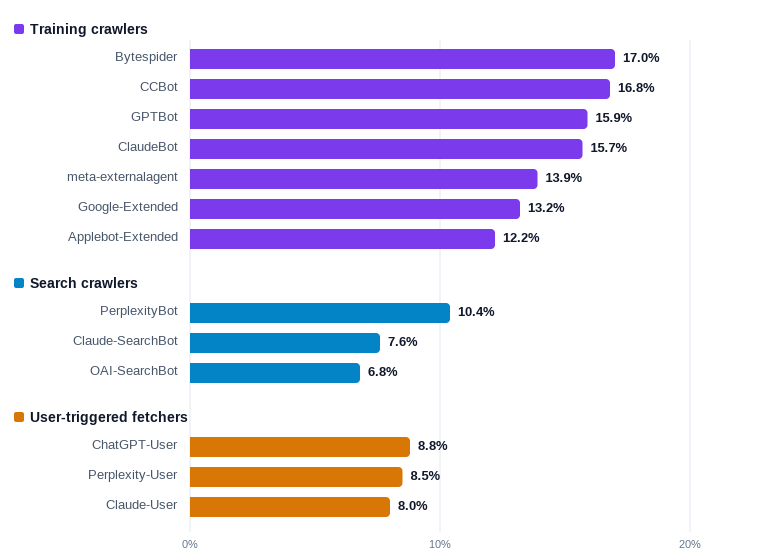
The pattern is clear: training crawlers are blocked roughly twice as often as the crawlers that power AI search. That matches the trade-off most site owners describe. Training crawlers take content for future models and send nothing back; search crawlers are how a site gets quoted and linked in ChatGPT search, Claude or Perplexity answers. If you're unsure which is which, our guide to AI crawlers in robots.txt lists each one and what blocking it affects.
OpenAI is the clearest case because it runs separate crawlers for the two jobs:

Of the 15.9% of sites that block GPTBot, more than half still let OAI-SearchBot in. Those sites have decided they don't want to be training data but do want to show up in answers, and robots.txt lets them say exactly that. Only 4.5% of sites block every AI crawler we checked, search included. Those are mostly large platforms with their own reasons, such as facebook.com, instagram.com, reddit.com and pinterest.com.
One in five sites turn away requests that identify as AI crawlers
robots.txt is a request, not a lock, and many sites now also filter bots at their CDN or firewall. So for every site we fetched the homepage three ways: as our own crawler, and with the user agents of GPTBot and ClaudeBot. A site counts below only if a request with an AI crawler’s user agent was rejected in two separate passes while our own request succeeded.
19.7% of sites answered a request identifying as GPTBot or ClaudeBot with an error (usually 403) or a challenge page, while serving our crawler normally. For 12.4% of sites this happens even though their robots.txt allows both crawlers; ibm.com, adobe.com and wordpress.com are examples. wikipedia.org served the GPTBot user agent but rejected the ClaudeBot one, although its robots.txt allows both.
That gap needs a careful reading, because we can only send a crawler's name, not its traffic. Requests from the real GPTBot come from OpenAI's published IP ranges, and some CDNs check that: a request that claims to be GPTBot but comes from anywhere else is treated as an impostor and blocked, while the real crawler is let through. wordpress.com said as much on the page it showed us (“Checking search engine crawler”). Other sites block AI crawlers outright, often with a single toggle such as Cloudflare’s “Block AI bots”, sometimes without the people who own the content knowing.
From the outside the two look the same, so treat the 19.7% as the share of sites where it’s worth checking. If you own one of them, look at your CDN’s bot settings and your logs: if requests from verified OpenAI, Anthropic and Perplexity crawlers are getting 403s, your robots.txt isn’t the setting that decides whether you appear in AI answers.
About 10% of sites are almost empty without JavaScript
Most AI crawlers download HTML and don't run JavaScript, so whatever a page builds in the browser is invisible to them (we explain why in Can AI crawlers read your React site?). In the HTML the servers sent us, 9.9% of homepages had fewer than 50 words of visible text and relied on scripts for the rest, and 17.5% had fewer than 100. The median homepage had 807 words in its HTML.
The biggest sites are more likely to be app shells: 17% of the top 100, against about 9% further down the list. youtube.com and spotify.com are among them. For a site like YouTube that's a deliberate choice, since it has other ways of being understood. For a smaller company whose homepage is a single-page app, it can mean an AI assistant has nothing to quote.
Basic markup: mostly there, with gaps in structured data
None of these are AI-specific, but they're what any crawler uses to work out what a page is, and AI search inherits them:
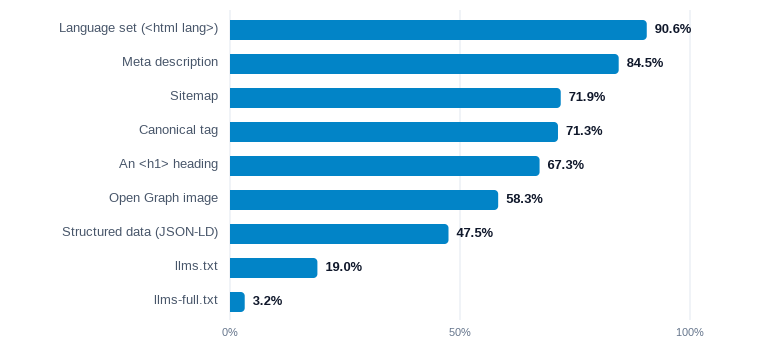
A third of homepages have no <h1>, and just under half carry any JSON-LD structured data. The most common types are WebSite (31% of all sites) and Organization (27%), the ones that tell a machine plainly whose site this is. Counting every organisation-type markup, 58% of homepages don’t make that statement in machine-readable form at all.
llms.txt: 19%, led by developer companies
llms.txt is a short markdown file at the site root that tells AI tools what the site is and which pages matter. No major AI search engine has said it uses the file (we went through the evidence in llms.txt: what it is, who reads it), but adoption is further along than we expected: 19% of the 1,000 sites publish one that passes basic validity checks, and 3.2% also publish llms-full.txt.
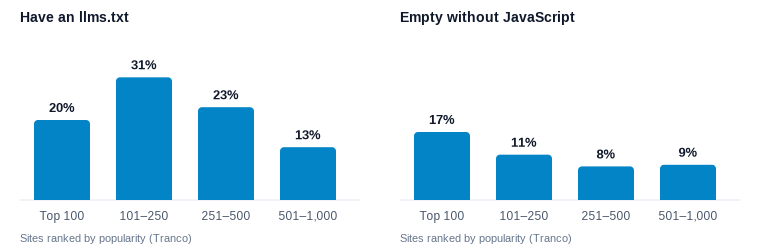
Adoption peaks among sites ranked 101–250, where developer platforms and infrastructure companies cluster: cloudflare.com, github.com, shopify.com and dropbox.com all publish one. Some of the files came from SEO plugins such as Yoast and All in One SEO, which now generate llms.txt automatically for WordPress sites. A few servers returned a JSON error or an empty file at /llms.txt with a 200 status; we didn’t count those.
What to check on your own site
- Decide training and search separately. If you block AI crawlers, block the training ones by name (GPTBot, ClaudeBot, Google-Extended, CCBot) and leave OAI-SearchBot, Claude-SearchBot and PerplexityBot allowed, unless you really want to stay out of AI answers.
- Check your CDN, not just robots.txt. Look at your bot settings and logs for verified AI crawlers getting 403s or challenges.
- Make sure the content is in the HTML. View the page source (not DevTools) and search for your main headline. If it isn’t there, pre-render or server-render public pages.
- Say what you are in markup. An Organization or WebSite JSON-LD block, a real <h1> and a meta description cost minutes and help every crawler.
- Add llms.txt if it’s cheap for you. It won’t move AI search traffic on its own, but developer tools and agents do read it.
Method and limits
- Sites. Tranco list
JZW4Y(generated 24 November 2026), taken in rank order until 1,000 domains served a working HTML homepage. That took the first 1,853 domains. We left out 495 that didn’t resolve or respond (mostly CDN and API domains that aren’t websites), 216 that blocked our own crawler, 82 that redirect to a site already counted (such as fbcdn.net to facebook.com), 50 whose homepage returned an error and 10 that served something other than HTML. - Checks. One homepage per site, fetched on 25 November 2026 by AnalyserBot from a single network location in India. robots.txt was evaluated per RFC 9309 for the homepage path, for 13 AI crawlers: 7 training (GPTBot, ClaudeBot, Google-Extended, Applebot-Extended, CCBot, Bytespider, meta-externalagent), 3 search (OAI-SearchBot, Claude-SearchBot, PerplexityBot) and 3 user-triggered (ChatGPT-User, Claude-User, Perplexity-User).
- Firewall check. The homepage was fetched with GPTBot and ClaudeBot user agents and compared with our own request, then re-checked in reverse order with pauses to rule out rate limiting. Only sites that rejected an AI user agent in both passes, while serving our crawler, count. HTTP 429 (too many requests) was not counted as a block.
- Content. Visible words in the HTML response, excluding scripts, styles and templates. “Almost empty” means fewer than 50 words with external scripts present.
- llms.txt. A 200 response at /llms.txt that isn’t HTML or JSON and looks like markdown text (a title line, or at least three lines).
- Limits. Homepages aren’t whole sites; robots.txt can treat other paths differently. Sites that block unknown crawlers are excluded, and they probably block AI crawlers more often too, so the real blocking rates are likely somewhat higher. Results are a snapshot: crawler policies change often.
The data is free to use with a link to this page. If you spot an error in how a site was classified, email support@analyser.dev.